

Lawson Completed “Jesse Owens Triple” In 2016
Jarrion Lawson flawlessly executed a simple plan to historic results in 2016.
Five years ago, Lawson became just the second athlete in the history of the NCAA Division I Outdoor Track & Field Championships to complete the 100-200-long jump triple in the same year. The other was Jesse Owens, who did so twice in 1935 and 1936 (Owens also added a victory in the 220-yard hurdles in each of those years, for good measure).
“I’m just thankful to God to be able to do the same things that Jesse Owens did,” Lawson said after the meet. “It’s just a great privilege and honor. It’s just amazing to come out and win three events. To be mentioned in the same sentence as Owens, I just thank God for it all.”
How did the eventual Bowerman winner intend to achieve such an audacious feat?
“I tried to take each event one at a time,” Lawson said. “I put all my focus into whatever event I’m in at the time. If I’m in the long jump, I put all my focus on the long jump. I treat them all with the respect they deserve and treat all my competitors with that same respect.”
Lawson won the long jump – his first event that year – in a rout. While it took three attempts to get his legs under him, Lawson soared 8.13m (26-8¼) in Round 4 to take over the lead for good and then extended that to 8.15m (26-9) in Round 5 to win by nearly nine inches.
The Razorback star returned to Historic Hayward Field two days later for a three-final outing, starting with the meet-opening 4×100 relay. He toted the baton second on that third-place squad and mentioned after the meet that “…the relay was a good warmup for the other events. It got my legs loose and I was able to carry over to the sprints.”
Lawson won a war of attrition against a stiff headwind in the 100 (-2.3 m/s), beating Christian Coleman of Tennessee to the finish line by 0.01 seconds – 10.22 to 10.23. In doing so, Lawson put his name alongside DeHart Hubbard (1925), Owens (1935 & 1936), Carl Lewis (1981) and Ngoni Makusha (2011) as the only athletes to capture the 100 and long jump in the same year.
That wasn’t enough for Lawson – not by a long shot.
Lawson left no doubt as to his place in history 45 minutes later with a decisive, 0.07-second victory over Coleman in the 200 – 20.19 to 20.26. Coleman led at 100 meters, but Lawson drew even 50 meters later and gradually pulled ahead to the point where he could spread his arms wide to celebrate over the last 10 meters.
The NCAA and collegiate track & field will mark a momentous milestone in the spring of 2021 -- the 100th anniversary of the NCAA Championships and with that, the NCAA Track & Field Championships. In June 1921, the University of Chicago hosted the first track & field championships in NCAA history.
This point can’t be emphasized enough: Not only was the event the first for NCAA track & field, but the first championships for any sport under the sponsorship of the NCAA.
To celebrate, over each of the next 365 days, the U.S. Track & Field and Cross Country Coaches Association (USTFCCCA) will celebrate moments, student-athletes, and coaches that have made a century’s worth of championships special. From humble beginnings to important historical milestones to the modern-day, collegiate track & field has evolved with the American society.
The 2021 edition of the NCAA Division I Outdoor Track & Field Championships begin with preliminary round action on May 27-29 in Jacksonville, Fla., and College Station, Texas. The championships final site and culmination of the celebration is slated for June 9-12, 2021 at the newly rebuilt Hayward Field in Eugene, Ore.

Spearmon Sprinted Past Stacked 200 Field
Wallace Spearmon Jr. won back-to-back 200m titles at the NCAA DI Outdoor T&F Championships in 2004 & 2005. He ran 19.91 (-0.7 m/s) in 2005 to beat a loaded field by 0.17 seconds.
Collegiate Record For BYU’s Andersen
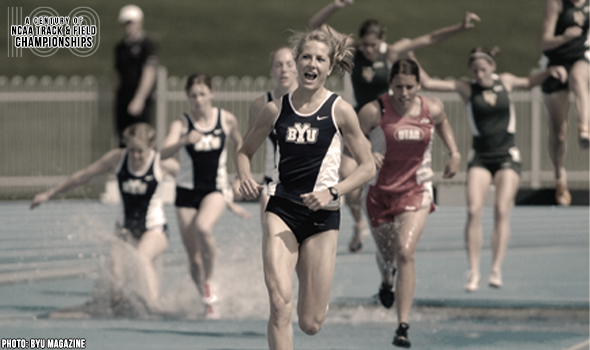
Kassi Andersen set a collegiate record in the steeplechase of 9:44.95 at the 2003 NCAA DI Outdoor T&F Championships, capping a three-year streak in which BYU athletes won the event.
Hook ‘Em, Ivan: Wagner Tied Best HJ Margin
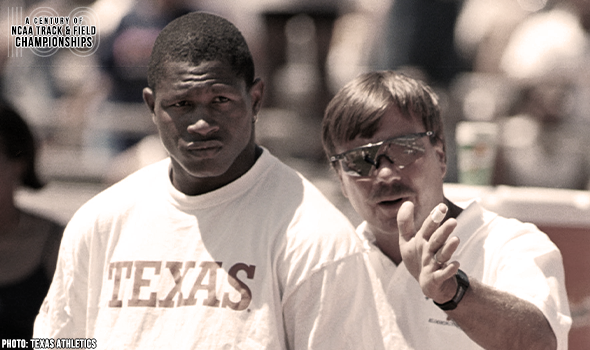
Ivan Wagner won the high jump at the 1997 NCAA Division I Outdoor T&F Championships by more than four inches to tie the largest margin of victory in meet history.
Mason’s Muzzio Starred In Decathlon
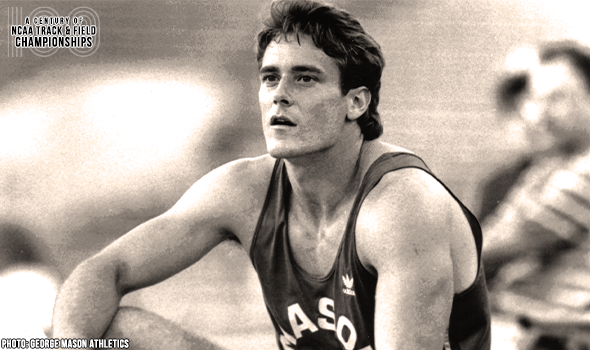
Rob Muzzio won back-to-back decathlon titles at the NCAA DI Outdoor T&F Championships in 1984 & 1985. His victory in 1985 was by 3 points, the smallest margin in meet history.

Roesler Dusted The Competition In 2014
Laura Roesler won the 800 at the 2014 NCAA Division I Outdoor T&F Championships with a negative split (61.06/60.16) & the 2nd largest margin of victory in meet history (1.70 seconds).

Fuchs Went Back-To-Back In Shot Put
Jim Fuchs won back-to-back shot put titles at the NCAA Outdoor Track & Field Championships in 1949 & 1950. He set a meet record in that first year, heaving the orb 17.10m (56-1½).
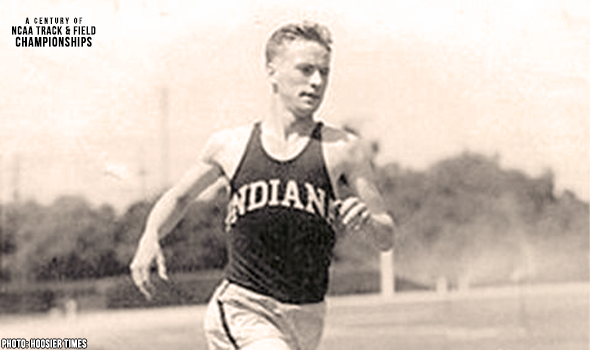
Lash Led Indiana Dominance In NCAA’s First 5K
Don Lash led a 1-2-4 finish by Indiana in the 5K at the 1936 NCAA Outdoor Track & Field Championships. It was the first time in meet history that one team had three top-4 finishers in that event.

Surprise! Brown’s Win Sent Texas A&M To Title
Kamaria Brown beat Jenna Prandini by 0.007 seconds for the 200-meter title at the 2014 NCAA Division I Outdoor Track & Field Championships. It was the smallest margin of victory in meet history.

Coleman Cruised To The Bowerman In 2017
Christian Coleman dazzled at the 2017 NCAA Division I Outdoor Track & Field Championships and set a collegiate record in the 100!
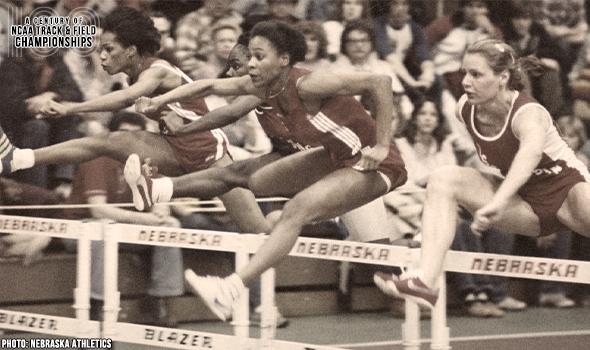
Blanford Blitzed 100H Record Book
Rhonda Blanford set an all-conditions meet record in the 100 Hurdles of 12.70 at the 1985 NCAA Division I Outdoor T&F Championships. She also won the race by 0.30 seconds!