

Surprise! Brown’s Win Sent Texas A&M To Title
0.007 seconds.
That infinitesimal speck of time, indiscernible to the naked eye, separated Kamaria Brown of Texas A&M and Jenna Prandini of Oregon at the finish line of the 200-meter final at the 2014 NCAA Division I Outdoor Track & Field Championships in Eugene, Oregon.
Never before had a finish in that event been so close.
So, when Brown edged Prandini for the title – 22.623 to 22.630 – it ushered in a new heiress to the Throne of Thrilling Finishes. You can cement that fact when you add Brown’s teammate, Olivia Ekponé, to the mix – who took third in 22.64, just 0.01 seconds behind Prandini.
That 1-3 finish by Brown and Ekponé sparked the Aggies on the meet’s final day as they racked up 34 points to propel them to their fourth team title in the past six years. Texas A&M also won the 4×100 relay with Brown handing off to anchor Ekponé, and took runner-up honors in the 4×400.
Brown’s 10 points in the 200 ended up being the difference as the Aggies beat archrival Texas by nine points, 75-66. And wouldn’t you know: Brown wasn’t expected to win – let alone score. She entered the meet ranked ninth nationally, but stepped up in a big way for Texas A&M.
The NCAA and collegiate track & field will mark a momentous milestone in the spring of 2021 -- the 100th anniversary of the NCAA Championships and with that, the NCAA Track & Field Championships. In June 1921, the University of Chicago hosted the first track & field championships in NCAA history.
This point can’t be emphasized enough: Not only was the event the first for NCAA track & field, but the first championships for any sport under the sponsorship of the NCAA.
To celebrate, over each of the next 365 days, the U.S. Track & Field and Cross Country Coaches Association (USTFCCCA) will celebrate moments, student-athletes, and coaches that have made a century’s worth of championships special. From humble beginnings to important historical milestones to the modern-day, collegiate track & field has evolved with the American society.
The 2021 edition of the NCAA Division I Outdoor Track & Field Championships begin with preliminary round action on May 27-29 in Jacksonville, Fla., and College Station, Texas. The championships final site and culmination of the celebration is slated for June 9-12, 2021 at the newly rebuilt Hayward Field in Eugene, Ore.
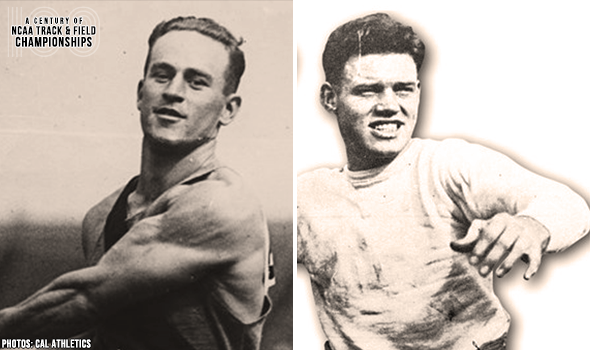
Merchant, Muller Led Cal’s Field Day In 1922
Jack Merchant and Harold Muller combined for six top-5 finishes in five field events at the 1922 NCAA Outdoor Track & Field Championships.
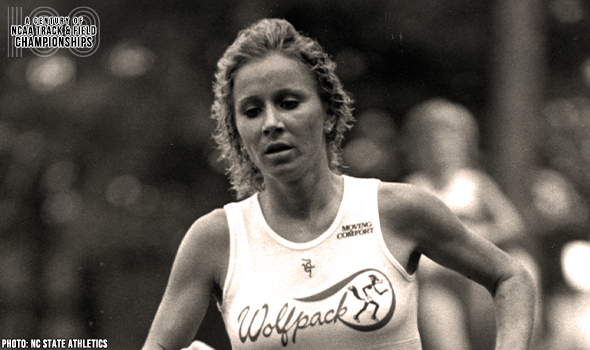
NC State’s Springs Doubles Up Distance Titles
In 1983, Betty Springs became the first woman in the history of the NCAA Division I Outdoor Track & Field Championships to sweep the 5K/10K titles.

“Marvelous Mal” Whitfield Stars Over Two Laps
“Marvelous” Mal Whitfield won back-to-back NCAA 800-meter/880-yard titles in 1948 and 1949.

Ewen Was A True Triple Threat At NCAAs
Maggie Ewen is the only woman in the history of the NCAA Division I Outdoor Track & Field Championships with titles in three different throwing events.

Wanamaker Wins Inaugural Decathlon Title
Rick Wanamaker of Drake won the first-ever decathlon title at the NCAA Division I Outdoor Track & Field Championships in 1970!

SMU’s Connor Bounds To Triple Jump Greatness
It’s been 38 years and still no one has broken the meet record Keith Connor of SMU set in the triple jump at the 1982 NCAA Division I Outdoor Track & Field Championships in Provo, Utah.

Hail Lorenzo! Daniel Sprints To 200-Meter Records
Lorenzo Daniel of Mississippi State made four consecutive appearances in the final of the Men’s 200 Meters and set a collegiate and meet record in his last race.

Talented Twins Dominate Pole Vault Podium
Twin sisters Lexi Jacobus and Tori Hoggard finished on the same podium five times in eight seasons at the NCAA Championships and each won an outdoor title.

Blozis Was A “Giant” In The Shot
“Giant” Al Blozis won three consecutive shot put titles at the NCAA Outdoor Championships between 1940 and 1942.

Cameron Came Close To Standing Alone
Two one-hundredths of a second separated Bert Cameron of UTEP from standing alone in NCAA history.